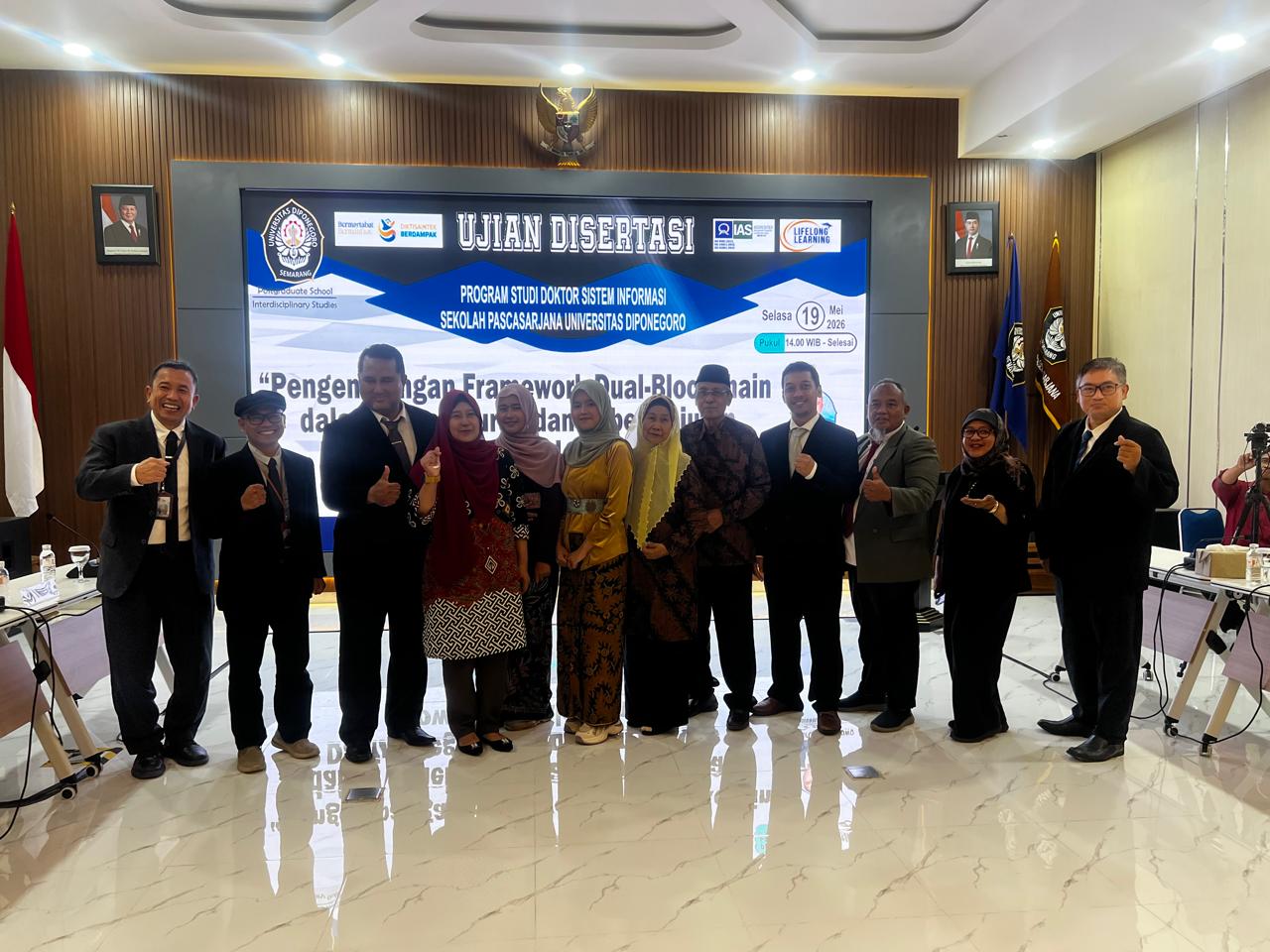
Developing a Blockchain Framework for Halal Meat, USM Faculty of Information and Communication Technology (FTIK) Lecturer Earns Doctorate in Information Systems from Diponegoro University.
Whisnumurti Adhiwibowo, S.T., M.Kom., a lecturer in the Informatics Engineering Undergraduate Program at the Faculty of Information and Communication Technology (FTIK) at the University of Semarang, officially earned a doctorate from the Information Systems Doctoral Program at Diponegoro University on Tuesday, May 19, 2026.
The degree was awarded after successfully defending her dissertation entitled “Developing a Blockchain Framework for Tracing and Sustaining Fresh Halal Meat Using the Crow Search Algorithm Method.”
The doctoral promotion defense was chaired by Prof. Ir. Mochamad Agung Wibowo, M.M., M.Sc., Ph.D., with Qidir Maulana Binu Soesanto, S.Si., M.Sc., Ph.D., as the defense secretary.
Meanwhile, Prof. Dr. Taqwa Hariguna, S.T., M.Kom from Amikom University, Purwokerto, served as external examiner.
In addition, Prof. Dr. Ir. Aries Susanty, S.T., M.T., IPU., ASEAN Eng., and Farikhin, S.Si., M.Si., Ph.D., also served as examiners.
The research promoter was Prof. Dr. Ir. Widayat, S.T., M.T., IPM., ASEAN Eng., with co-promoter Dr. Eng. Ir. Wahyul Amien Syafei, S.T., M.T., IPM.
USM Vice Rector III, Dr. April Firman Daru, S.Kom., M.Kom., stated that Whisnumurti became the 14th doctorate in the Faculty of Computer Science and Technology (FTIK) USM.
“Dr. Whisnumurti Adhiwibowo has not only produced innovative work, but also a tool that can detect and validate the halal status of meat, ensuring the public’s confidence in its distribution,” said Dr. April Firman Daru.
In her research, Whisnumurti highlighted the issue of traceability and halal assurance of fresh meat in traditional markets, which still face various challenges, ranging from information transparency, data integrity, halal validation, to recording distribution conditions.
“This research aims to develop a dual-blockchain framework artifact for the traceability and sustainability of halal fresh meat, integrating blockchain transactions for recording halal activities and blockchain IoT for recording temperature and humidity during distribution,” explained Dr. Whisnumurti Adhiwibowo.
She added that the research was conducted using a Design Science Research (DSR) approach combined with the System Development Life Cycle (SDLC), from the planning, design, implementation, and evaluation stages of the system.
“The research approach uses Design Science Research (DSR) combined with the System Development Life Cycle (SDLC) through the planning, design, implementation, and evaluation stages of the system. The halal validation mechanism is implemented through Proof of Authority (PoA), which positions the RPH supervisor and JULEHA as authorized validators. While the Crow Search Algorithm (CSA) is used to process sensor data and determine minimum and maximum values as indicators of extreme distribution conditions,” he added.